
Key takeaways
- Most land problems hide in the paperwork, not in the soil.
- Ask for title history, land records, an encumbrance certificate and a survey sketch.
- The seller’s name must match across every document.
- Use this checklist with a property lawyer, not instead of one.
Buying agricultural land is one of the larger decisions a family makes, and often one of the least familiar. The land may look perfect on a site visit. The paperwork is where most problems hide: a missing link in the ownership chain, a loan nobody mentioned, a boundary that does not match the sketch, or a buyer who was never eligible to buy in the first place.
This guide walks through the main documents to ask for in Karnataka and Andhra Pradesh, what each one tells you, and the red flags to look for. Please have a qualified property lawyer review them for your specific purchase. Use the interactive checklist at the end to track what you have received.
The four papers your lawyer reads first
- 1Title deedAnd the chain of earlier deeds that leads to it.
- 2Land recordRTC in Karnataka, Adangal and 1-B in Andhra Pradesh.
- 3Encumbrance certificateUsually around 30 years of registered transactions.
- 4Survey sketchExtent and boundaries, checked on the ground.
The documents at a glance
What to collect, in the order a lawyer usually checks it
- 01Title deedThe current sale deed and the chain of earlier deeds.
- 02Land recordsRTC in Karnataka; Adangal and 1-B in Andhra Pradesh.
- 03Encumbrance certificateRegistered sales, mortgages and charges over the years.
- 04Survey sketchThe plot’s extent and boundaries, checked on site.
- 05EligibilityWhether you are allowed to buy this type of land.
- 06Agreement and registrationThe management agreement and a sale deed in your name.
Your document kit
1. Title and ownership history
Ask for the current title deed and the chain of previous sale deeds, ideally going back 30 years. Each transfer should be registered, and the names should connect without gaps: the buyer in one deed should be the seller in the next.
Be careful
Watch for gaps in the chain, a transfer by power of attorney rather than a sale, or land that came to the seller through a will or partition without the other heirs signing. Each of these needs a lawyer’s opinion.
2. Land records
Land records are kept by the state revenue department and show who the land is recorded to, its extent and how it is classified. The owner in the land records should match the seller in the deed.
Land records by state
- RTC (Pahani): the Record of Rights, Tenancy and Crops. Shows the owner, extent, land type and crops recorded.
- Mutation register: shows how ownership changed in the records over time.
- Records can be viewed on the state’s Bhoomi land records service.
- Adangal (Pahani): the village account showing the land’s details and cultivation.
- 1-B (ROR): the Record of Rights showing the recorded owner.
- Records can be viewed on the state’s Meebhoomi land records service.
3. Encumbrance certificate
The encumbrance certificate (EC) lists registered transactions on the land, such as sales, mortgages and some other charges, over a period you choose. Ask for one covering at least 30 years if possible. A clean EC does not prove everything, because some claims are never registered, but a mortgage or a sale you were not told about is an immediate red flag.
Quick check
The EC shows a bank mortgage on the land from three years ago, and no release. What should you ask for?
Ask for the loan closure letter and a registered release of the mortgage, and have your lawyer confirm the charge is gone before you pay.
4. Survey sketch and boundaries
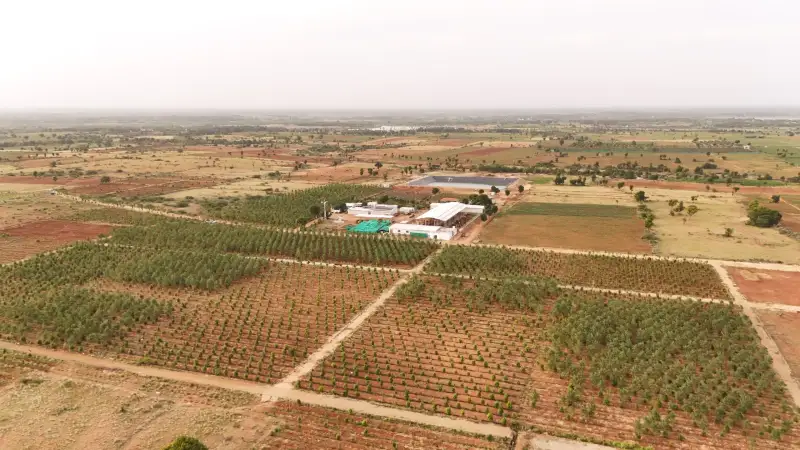
A survey sketch confirms the plot’s extent and its boundaries against the survey number. Walk the boundary on your site visit and check it against the sketch. In a managed farm, you should be able to see exactly which plot is yours, with its own number and markers.

How a lawyer usually checks a plot
- Deeds
- Records
- EC
- Sketch on site
- Clear to buy
5. Eligibility to buy
Some states have rules on who can buy agricultural land, and these change over time. Karnataka relaxed its rules in 2020. Andhra Pradesh has its own rules. Non-resident Indians face restrictions under FEMA. Confirm your eligibility with your lawyer before paying anything. If you live abroad, read can NRIs buy farmland in India?
Be careful
Some land cannot legally be sold at all, for example land granted by the government under certain schemes. Your lawyer should confirm the land is freely transferable.
6. For managed farmland: the management agreement
If a farm company will run your land, the management agreement matters as much as the deed. Read it slowly, and ask for anything vague to be made specific.
Scope
Term and exit
Produce sharing
Reporting
Permissions
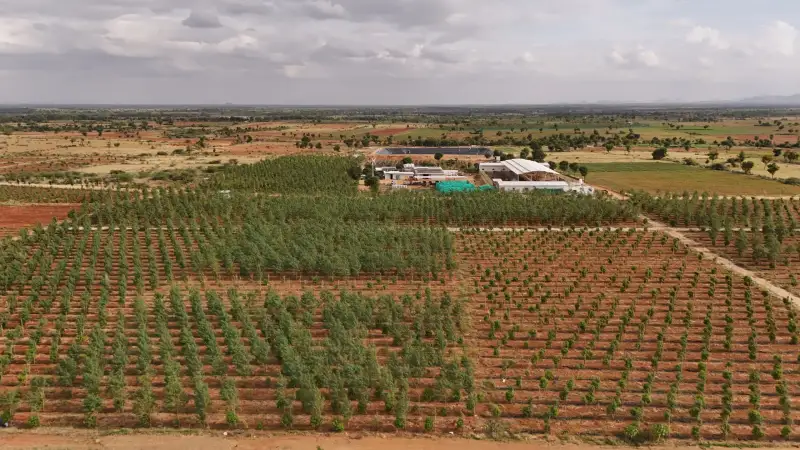
See how plots are laid out
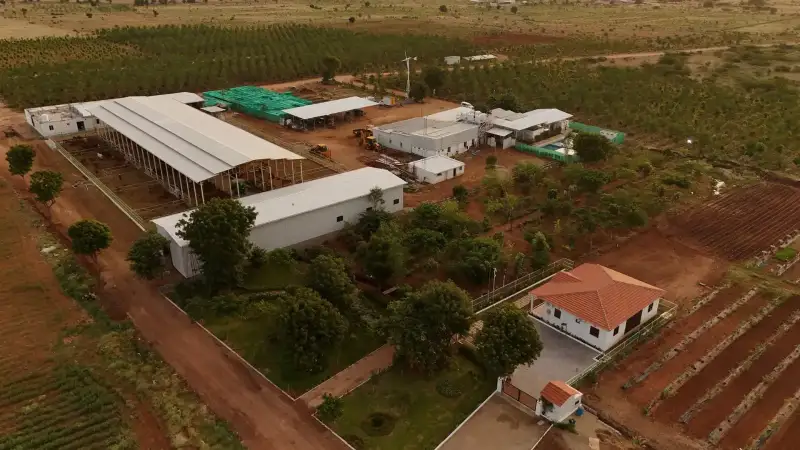
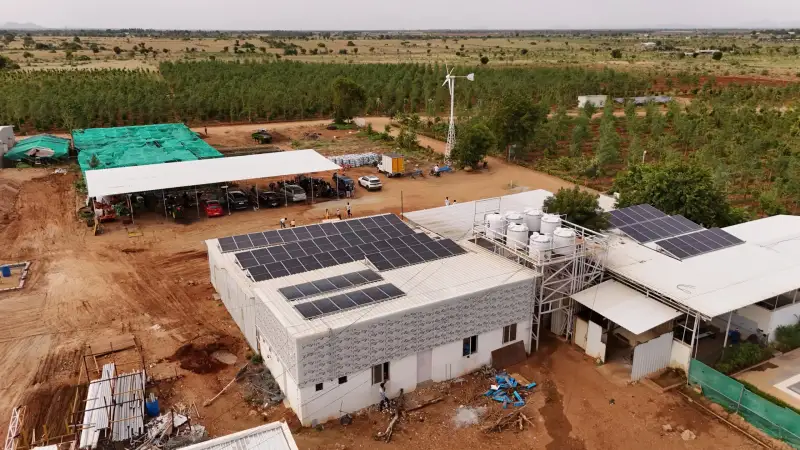
Aerial drone tour of GreenX
From our own YouTube channel, @smartagrofarms.
7. Registration in your name
The sale deed should be registered in your name at the Sub-Registrar Office, with the stamp duty and registration fee paid as required. Be very careful with any arrangement that uses a power of attorney instead of a registered sale. Payments should go by bank transfer or cheque to the seller’s account, never in cash, so there is a clear record.
Your document checklist
0 / 8All checked. Take this list to your lawyer and your site visit.
Was this guide useful?
Thank you. Tell us what to cover next on WhatsApp.Reading is one thing. Walking the farm is another.
Come for a site visit, stand on the plots and ask our team whatever is on your mind.